J. Biosci. Public Health. 2026; 2(4)

First and Corresponding Author
https://orcid.org/0000-0003-1388-0740
Affiliations:
Department of Fish Processing Technology, Faculty of Fisheries, Fırat University, Elazığ, Türkiye
Coauthor
https://orcid.org/0000-0001-9239-6847
Affiliations:
Department of Fish Processing Technology, Faculty of Fisheries, Fırat University, Elazığ, Türkiye
Coauthor
https://orcid.org/0000-0003-2073-8101
Affiliations:
Department of Fish Processing Technology, Faculty of Fisheries, Fırat University, Elazığ, Türkiye
Fresh fish spoils rapidly, and conventional petroleum-based packaging provides limited protection against the oxidative and proteolytic reactions that restrict its shelf life. This study evaluated whether combining quince seed mucilage (QSM) with zinc oxide nanoparticles (ZnO-NPs) in a chitosan produces a bionanocomposite film with greater protective capacity than either component alone. Rainbow trout (Oncorhynchus mykiss) fillets were coated with chitosan (C), chitosan/quince seed mucilage (C/QSM), chitosan/1% ZnO-NPs (C/1%ZnO-NP), chitosan/quince seed mucilage/1% ZnO-NPs (C/QSM/1%ZnO-NP) films and stored at 4°C for 15 days. pH, peroxide value (PV), thiobarbituric acid (TBA), total volatile basic nitrogen (TVB-N) and sensory attributes were investigated. ZnO-NP-containing films kept TVB-N below the 35 mg N/100 g acceptability limit throughout storage, whereas C and C/QSM exceeded it by day 12 (35.80 and 35.04 mg N/100 g). TBA values remained below 8 mg malondialdehyde (MDA)/kg in all groups, with C/QSM/1%ZnO-NP the lowest (p<0.05). Sensory shelf life was 9 days for C and C/QSM and 12 days for both ZnO-NP groups. QSM–ZnO-NP bionanocomposite films therefore represent a biodegradable active packaging option for highly perishable seafood.
Advanced packaging materials are expected to satisfy regulatory standards and consumer demands while minimizing environmental impact. About 37% of the food packaging sector relies on petroleum-derived plastics because of their low production cost, ease of transport, high strength, light weight and shape versatility [1]. These materials, however, persist in the environment after disposal [2]. Because maintaining food freshness and shelf life remains a central challenge for the food industry, and because health and environmental concerns are growing, researchers have increasingly turned to bio-derived polymers as alternatives to petroleum-based plastics. Environmentally friendly polymers extracted from natural sources such as proteins and carbohydrates have been used to produce biodegradable films, opening new prospects for sustainable commercial packaging. Among the available biopolymers, chitosan, starch and cellulose are widely used because of their biodegradability, renewability, biocompatibility and excellent film-forming capacity [3].
Chitosan is one of the most abundant biopolymers in nature. It is produced by deacetylation of chitin and consists of repeating units of β-(1→4) glycosidically bound 2-acetamido-2-deoxy-β-D-glucose and N-acetyl-2-amino-2-deoxy-D-glucosamine [4]. It is biocompatible, degradable, non-toxic and possesses natural antimicrobial activity against a broad range of bacteria, which has made it attractive in pharmaceutical as well as active food packaging applications. Many polymers have been blended with chitosan for packaging purposes, one of them being quince seed mucilage (QSM) [5]. The water-soluble polysaccharide fraction of QSM has been described as a partially O-acetylated (4-O-methyl-D-glucurono)-D-xylan containing an exceptionally high proportion of glucuronic acid residues. QSM films are hydrophilic and exhibit good barrier, mechanical and antioxidant properties, and their tasteless, odorless and antimicrobial character makes them suitable as food packaging materials [6].
Bioactive packaging has attracted the food industry because of the rapid increase in consumer demand for preservative-free alternatives [4]. Natural antimicrobial agents and metal nanoparticles are deliberately incorporated into the film to inhibit microbial growth, maintain quality and extend the shelf life of the packaged product. Several nanoparticles (NPs) have been successfully incorporated into polymer matrices to enhance their physicochemical and biological properties, and metal nanoparticles are the principal additives used in bioactive packaging systems. Among them, ZnO-NPs are the most extensively studied, owing to their low-cost synthesis, ease of use and high inhibitory capacity against microbial growth; they can be produced by both chemical and green routes [7]. ZnO-NPs have a high surface area and a hydrophilic surface, which promotes particle aggregation, although surface modification can prevent agglomeration and improve compatibility between the nanoparticles and the polymer [8].
Fresh fish spoils faster than red meat because of its high content of free amino acids and volatile nitrogen bases and its higher ultimate pH. Technological interventions such as freezing, drying, marinating and smoking are therefore applied to delay spoilage, and packaging strategy exerts a strong additional influence on quality and shelf life. Several edible and biodegradable films have been investigated for this purpose [9]. Nevertheless, studies applying bionanocomposite films to fish and fishery products remain scarce, and to the best of our knowledge no study has evaluated the joint incorporation of QSM and ZnO-NPs into chitosan for fish preservation.
Our previous study [10] focused on the in vitro characterization of chitosan/QSM/ZnO films, evaluating their physicochemical and bioactive properties. However, no research has yet examined their direct application to fish fillets under refrigerated storage. The present work therefore extends that earlier study by testing the films in rainbow trout fillets, providing practical shelf-life data and demonstrating their applicability in seafood preservation.
The aim of this study was to compare the effects of chitosan films containing QSM and 1% ZnO-NPs on lipid oxidation, protein degradation, and sensory acceptability in rainbow trout (Oncorhynchus mykiss) fillets stored at 4°C, and to determine whether the combination of the two additives provides superior protection compared to the use of each additive alone.
2.1.1 Rainbow trout (Oncorhynchus mykiss)
Fish (average weight 350–400 g; n = 4) were obtained fresh from a rainbow trout farm in Elazıg. On arrival at the laboratory, the head, viscera, skin and bones were removed and fillets were prepared. The fillets were washed thoroughly and cut into 4 × 6 × 2 cm pieces weighing 50 ± 5 g before coating.
2.1.2 Reagents
Chitosan (low molecular weight, deacetylated chitin, poly(D-glucosamine)), zinc oxide nanoparticles (nanopowder, ≤20 nm particle size), glycerol (≥99.5%), acetic acid (E260), magnesium oxide (MgO), hydrochloric acid (HCl), sodium thiosulphate (Na₂S₂O₃), boric acid (H₃BO₃), butylated hydroxytoluene (BHT), trichloroacetic acid (TCA) and 120 × 17 mm glass Petri dishes were purchased from Sigma-Aldrich. Quince seeds were obtained from a commercial plant seed supplier.
2.2. Methods
2.2.1 Preparation of quince seed mucilage (QSM) solution
QSM was prepared according to Ghumman et al. [11]. Quince seeds were cleaned by immersion in ethanol and dried in an oven at 45 ± 1°C for 3 h. The seeds were then immersed in distilled water (1:35 w/v) and stirred on a hot magnetic stirrer at 30 °C for 1 h. The swollen seeds were centrifuged at 12 000 rpm to separate the mucilage layer from the seed surface, and the filtered mucilage was dried in 120 × 17 mm glass Petri dishes at 45 ± 1 °C for 12 h. The dried QSM powder was stored in a dry place until use. The film-forming solution was prepared by dispersing 5 g of dried QSM powder in 100 mL of distilled water and stirring at room temperature until complete dissolution.
2.2.2 Preparation of chitosan solution
The chitosan solution was prepared according to [12]. Chitosan (1 g) was dissolved in 100 mL of 1% (v/v) acetic acid and stirred on a magnetic stirrer (Hot & Stirrer-Tepe, MS300HS) for 12 h at room temperature. Insoluble particles were removed by centrifugation (Nüve NF 800R) at 5000 rpm for 5 min.
2.2.3 Preparation of bionanocomposite films
Bionanocomposite films were prepared as in our previous study [10]. Briefly, the QSM and chitosan solutions were mixed for 15 min to obtain a homogeneous blend. Glycerol (0.06 mL/100 mL) was added as a plasticizer, and the mixture was stirred for a further 30 min without heating. ZnO-NPs at 1% (w/v), a level determined in preliminary trials, were then added and mixed for 10 min. To remove air bubbles, the homogenized solution was centrifuged at 3000 rpm for 10 min. Aliquots of 20 mL were poured into 120 × 17 mm Petri dishes and dried at 35 °C for 24 h to form the films (Figure 1b). All films were prepared in duplicate. The four treatments were: C (control): chitosan film solution.
C/QSM: chitosan film solution containing 50% (v/v) QSM solution.
C/1%ZnO-NP: chitosan film solution containing 1% (w/v) ZnO-NPs dispersed in 1% acetic acid.
C/QSM/1%ZnO-NP: chitosan film solution containing 50% (v/v) QSM solution and 1% (w/v) ZnO-NPs.
2.2.4 Coating of fillets
Trout fillet pieces (4 × 6 × 2 cm, approximately 50 g) were coated with the films described above (Figure 1). Coated fillets were placed in polystyrene trays, stored at 4 °C and analyzed for chemical (pH, TVB-N, TBA, PV) and sensory (color, odor, overall acceptability) quality at 3-day intervals over 15 days. The experiment was performed in two independent replications. The overall experimental design and film application are illustrated in Figure 1.
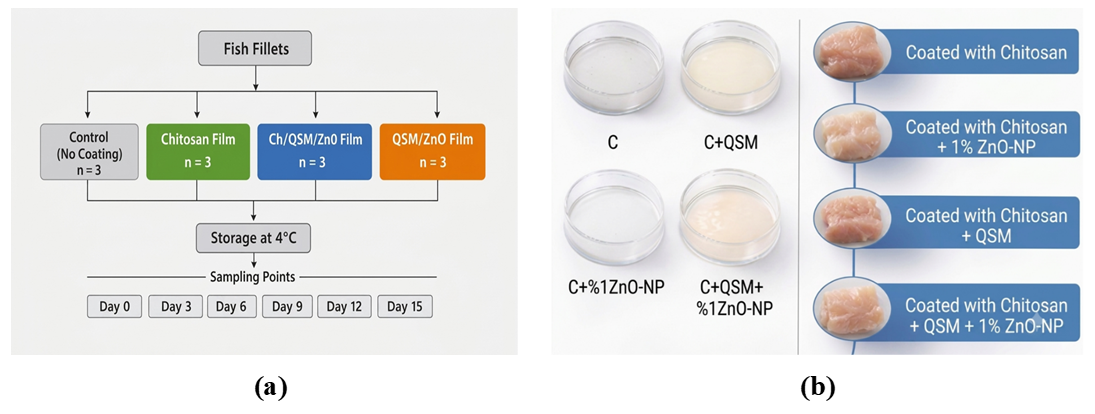
Figure 1. (a). Schematic representation of the experimental design showing treatment group; (b). mucilage-based bionanocomposite films and their application to rainbow trout fillets.
2.2.5 Proximate composition
Moisture was determined by the drying oven method (AOAC method 950.46), crude protein by the micro-Kjeldahl method (method 928.08), crude fat by Soxhlet extraction (method 960.39) and ash by incineration (method 920.153), AOAC [13]. pH was measured with a digital pH meter (EDT GP 353) after homogenizing 5 g of sample in 50 mL of distilled water for 1–2 min (Ultra-Turrax T25 digital, IKA, Staufen, Germany). All analyses were performed in triplicate.
2.2.6 Total volatile basic nitrogen (TVB-N)
TVB-N was determined according to literature [14]. A 20 g sample was mixed with 100 mL of distilled water, transferred to a distillation flask, made up to 250 mL with distilled water, and 2 g of MgO was added. The distillate was collected in a flask containing 10 mL of 3% boric acid and eight drops of Tashiro indicator and titrated with 0.1 N HCl. TVB-N was calculated as: TVB-N (mg N/100 g) = (1.4 × V × 100) / m
where V is the volume of 0.1 N HCl consumed (mL) and m is the sample mass (g).
2.2.7 Thiobarbituric acid (TBA)
TBA was determined according to Tarladgis et al. [15], as described by Varlık et al. [16]. A 2 g sample was homogenized (Ultra-Turrax T25 digital, IKA, Staufen, Germany) for 2 min with 100 µL of 0.1% BHT (1 g/L in ethanol) and 25 mL of 5% TCA. The homogenate was filtered, 2 mL of the filtrate was transferred to a tube, and 2 mL of freshly prepared TBA reagent was added. Sealed tubes were held in a water bath at 95 °C (DLAB DBW20, RT+5) for 30 min, cooled, and absorbance was read against a blank at 538 nm (UV-VIS spectrophotometer UV-120, Shimadzu). Absorbance values were multiplied by a factor of 7.8 and results expressed as mg malondialdehyde (MDA)/kg.
2.2.8 Peroxide value (PV)
PV was determined according to previous report [17]. Fat was first extracted from the fish flesh. To 2 g of the extracted fat, 30 mL of acetic acid/chloroform (3:2, v/v) was added and mixed, followed by 1 mL of saturated potassium iodide (KI) solution. The mixture was held in the dark for 5 min, 75 mL of distilled water and a few drops of starch solution were added, and the mixture was titrated with 0.1 M Na₂S₂O₃. PV was calculated as:
PV (mmol O₂/kg) = K × (V − V₀) × 12.69 × 78.8 / m
where K is the concentration of the Na₂S₂O₃ solution (mol/L), V is the volume of Na₂S₂O₃ consumed by the sample (mL), V₀ is the volume consumed by the blank (mL) and m is the sample mass (g).
2.2.9 Sensory analysis
Coated fillets stored at 4 °C were evaluated every three days by fifteen panellists selected from the academic staff and students of the Faculty of Fisheries. Samples were coded (C, C/QSM, C/1%ZnO-NP, C/QSM/1%ZnO-NP) and presented raw, without cooking. Color, odor and overall acceptability were scored on a 9-point hedonic scale, where 1 = dislike extremely, 2 = dislike very much, 3 = dislike moderately, 4 = dislike slightly, 5 = neither like nor dislike, 6 = like slightly, 7 = like moderately, 8 = like very much and 9 = like extremely. Samples scoring below 4 were considered rejected [18].
2.2.10 Statistical analysis
All measurements were performed in triplicate on samples from two independent replications. Results were evaluated by one-way analysis of variance (ANOVA), and means were compared using Duncan’s multiple range test (SAS v9.2, SAS Institute, Cary, NC, USA) at p<0.05.
3.1. Proximate composition of Oncorhynchus mykiss
The proximate composition of the raw material is presented in Table 1, together with published values for the same species. Moisture, crude protein, crude fat and crude ash contents were 75.51 ± 0.58%, 19.09 ± 0.11%, 2.62 ± 0.20% and 1.80 ± 0.46%, respectively. Crude protein was comparable with the reported values [18, 19], whereas the crude fat content was markedly lower than that earlier report [18] and closer to the value of another report [20]. The chemical composition of fish varies with diet, habitat, body size, fishing season and sex, as well as other environmental factors, and this variation influences the attributes that govern acceptability, including taste, odor, texture, color and appearance [18].
Table 1. Proximate composition (%) of rainbow trout (Oncorhynchus mykiss) fillets used in this study, compared with published values.
| Component | This study | Hassanzadeh et al. [19] | Gurel İnanlı et al. [20] |
| Moisture | 75.51 ± 0.58 | 71.12 ± 0.22 | 71.10 |
| Crude protein | 19.09 ± 0.11 | 22.11 ± 0.71 | 19.44 |
| Crude fat | 2.62 ± 0.20 | 2.10 ± 0.43 | 6.10 |
| Crude ash | 1.80 ± 0.46 | 4.40 ± 0.42 | 1.29 |
Values are means ± standard deviation of three determinations.
3.2. Physicochemical parameters
3.2.1 Effect of pH
Changes in pH during refrigerated storage are shown in Figure 2a. The initial pH of the trout flesh was 6.30, in agreement with the range of 6.0–6.5 reported for fresh fish [21]. Although pH initially decreased in all groups, it increased subsequently in every group during storage. This rise is mainly attributable to the accumulation of alkaline compounds generated by microbial activity in fish muscle [22]. On the final day of storage, the pH of the C and C/QSM groups was 6.10 and 6.11, respectively, while pH values in the C/1%ZnO-NP and C/QSM/1%ZnO-NP groups were significantly lower (p<0.05). These results indicate that ZnO-NPs incorporated into the chitosan coating effectively retard endogenous enzyme activity and bacterial growth. Foumani et al., [23] produced a chia seed mucilage-based edible film containing ZnO-NPs and applied it to chicken fillets stored under refrigeration for 20 days, likewise detected a significant difference in pH between ZnO-NP-containing samples and the control (p<0.05).
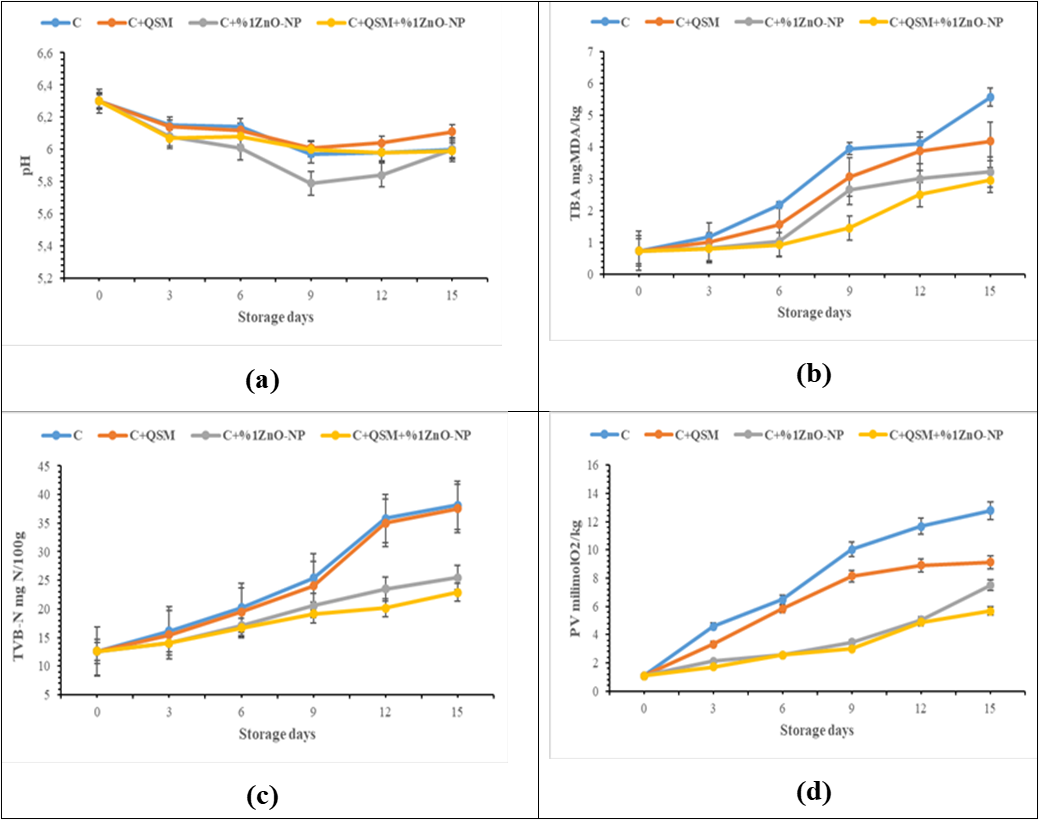
Figure 2. Changes in physicochemical parameters of coated rainbow trout fillets during storage at 4°C: (a). pH, (b). TBA (mg MDA/kg), (c). TVB-N (mg N/100 g), and (d). PV (mmol O₂/kg). Here, C: chitosan; C/QSM: chitosan/quince seed mucilage; C/1%ZnO-NP: chitosan/1% ZnO nanoparticles; C/QSM/1%ZnO-NP: chitosan/quince seed mucilage/1% ZnO nanoparticles. Error bars represent standard deviation.
3.2.2 TBA
TBA values were significantly lower in the groups coated with films containing 1% ZnO-NPs than in the C and C/QSM groups (Figure 2b). The lowest lipid oxidation values throughout storage were recorded in the C/QSM/1%ZnO-NP group (p<0.05). ZnO-NPs are known to exhibit antioxidant activity [24], and the present results indicate that combining QSM with ZnO-NPs further enhanced the capacity of the films to retard oxidative processes. TBA values in all groups remained below the consumable limit of 8 mg MDA/kg over the 15-day storage period [16]. Panea et al., reported that the addition of ZnO and Ag nanoparticles to LDPE packaging retarded lipid oxidation in chicken breast [25]. Another study prepared nanocomposite films based on carboxymethylcellulose (CMC), okra mucilage and ZnO-NPs for chicken breast stored at 4°C, found that films containing both okra mucilage and ZnO-NPs generally produced lower levels of lipid oxidation [26].
3.2.3 TVB-N
TVB-N is an important physicochemical index of fish freshness and safety. During storage, enzymatic degradation and microbial growth break down protein and generate alkaline nitrogenous compounds, including ammonia and amines [9]; an increase in TVB-N therefore indicates spoilage.
Changes in TVB-N are shown in Figure 2c. The initial TVB-N content of the fillets was 12.58 mg N/100 g, similar to the value reported by Korkmaz et al. [27] however, higher than those of previous reports [18, 19]. Fish harbor large numbers of bacteria in the digestive tract and produce strong digestive enzymes during feeding, which can cause rapid post-mortem autolysis in the later stages of storage and result in pronounced off flavors associated with protein breakdown and the production of volatile nitrogenous compounds [28, 29].
TVB-N increased significantly in all groups during storage (p<0.05). However, fillets coated with films containing 1% ZnO-NPs showed significantly lower TVB-N values than those coated with C and C/QSM films at the end of storage (p<0.05), and the C/QSM/1%ZnO-NP group maintained the lowest values throughout (p<0.05). Taking 35 mg N/100 g as the limit of acceptability [16], the C and C/QSM groups exceeded this threshold on day 12 (35.80 and 35.04 mg N/100 g, respectively), whereas the C/1%ZnO-NP and C/QSM/1%ZnO-NP groups remained at approximately 25 mg N/100 g and did not exceed the limit at any point. It is reported comparable findings for trout fillets coated with chitosan enriched with sumac extract and found that TVB-N in rainbow trout coated with quince seed mucilage films containing thyme essential oil reached the acceptability limit after 8 to 11 days [29, 30]. The lower TVB-N contents observed here may be attributed to the antimicrobial effect of the ZnO-NPs, which slows the growth of the spoilage microflora and reduces the bacterial capacity for oxidative deamination of non-protein nitrogen compounds. Similar results have been reported earlier by [26, 28]. Although ZnO-NPs are widely reported in the literature to possess antimicrobial activity, no microbiological counts were performed in this study. Therefore, the lower TVB-N values observed in the treated groups may be attributed to the potential antimicrobial effect of ZnO-NPs, as suggested by previous reports, rather than being directly demonstrated here.
3.2.4 Peroxide value
Lipid oxidation is one of the principal challenges in the storage of fish flesh. The early stage of fat oxidation is assessed by measuring peroxides, since hydroperoxides are formed during the initial phase of oxidation [28]. Changes in PV during storage are shown in Figure 2d. PV in the C/QSM group was significantly lower than in the C group (p<0.05), showing that the addition of quince seed mucilage to chitosan films was effective in reducing lipid oxidation. Jouki et al. reported that a quince seed mucilage layer on the fish surface is resistant to oxygen diffusion and can therefore delay lipid oxidation [29]. PV values in the groups supplemented with 1% ZnO-NPs were lower than in the remaining groups, which may be attributed to the antioxidant properties of zinc: Zn²⁺ can reduce lipid peroxidation by scavenging free radicals and lowers the production of malondialdehyde while influencing superoxide dismutase (SOD) activity. The antioxidant properties of ZnO-NPs have been reported [31]. Importantly, the combined use of QSM and 1% ZnO-NPs slowed the primary peroxidation process significantly more than 1% ZnO-NPs alone (p<0.05), indicating that the two components act in a complementary manner rather than additively.
3.3. Sensory properties
Sensory acceptability is a key quality parameter governing product acceptance. Sensory results (color, odor and overall acceptability) are presented in Figure 3.
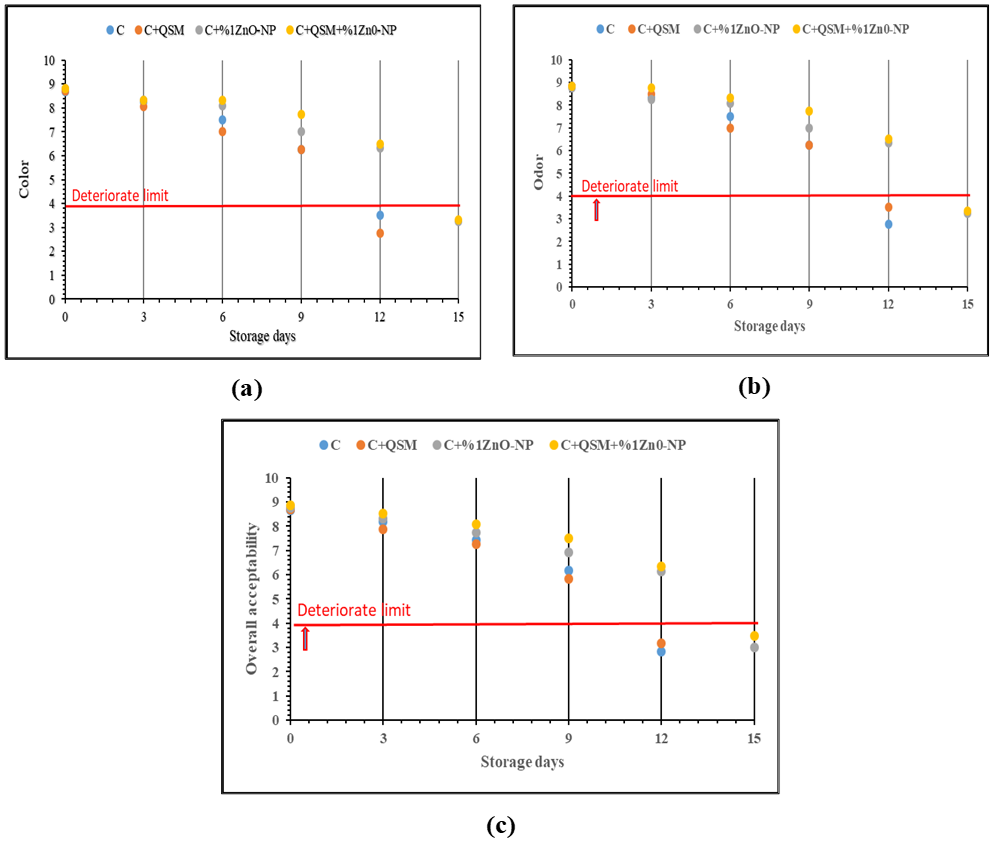
Figure 3. Changes in sensory properties of coated rainbow trout fillets during storage at 4 °C: (a) color, (b) odor, (c) overall acceptability. Abbreviations as in Figure 2. The dashed line at score 4 indicates the limit of acceptability.
Sensory scores decreased significantly in all groups during storage (p<0.05). Color scores fell to the acceptability threshold of 4 on day 12 in the C and C/QSM groups and on day 15 in the C/1%ZnO-NP and C/QSM/1%ZnO-NP groups (Figure 3a). Changes in fish color during storage can be attributed to enzymatic and non-enzymatic reactions that degrade myofibrillar proteins and disorganize the myofibrils [32]. The effect of ZnO-NPs on odor was significant (p<0.05): off-odors appeared on day 12 in the C and C/QSM groups and on day 15 in the C/1%ZnO-NP and C/QSM/1%ZnO-NP groups (Figure 3b). According to previous report [33], the first stage of quality deterioration in fish flesh is driven mainly by enzymatic autolysis and the second by microbial action; the resulting changes in color, odor and texture render the product organoleptically unacceptable (Figure 3c). On the basis of overall acceptability, the last day on which samples remained acceptable was day 9 for the C and C/QSM groups and day 12 for both ZnO-NP-containing groups.
The addition of quince seed mucilage and 1% ZnO nanoparticles to chitosan films significantly slowed the quality loss of rainbow trout fillets during cold storage (p<0.05). Fillets coated with QSM–ZnO bionanocomposite films exhibited fewer physicochemical and sensory changes compared to those coated with chitosan alone. The incorporation of ZnO-NPs enhanced the antioxidant capacity of the films, resulting in lower PV and TBA values. Moreover, TVB-N levels remained below the acceptable limit throughout the 15-day storage period. In sensory evaluations, C/QSM/1%ZnO-NP films received the highest scores; ZnO-NP-containing groups were acceptable for 12 days, whereas the other groups reached the threshold value after 9 days (p<0.05). The high content of unsaturated fatty acids in fish flesh increases its susceptibility to oxidation. These findings demonstrate that chitosan films containing QSM and ZnO-NPs hold promise as an environmentally friendly packaging alternative for extending the shelf life of rainbow trout and other seafood products.
This study was produced from the master's thesis which it's title “The Effect of Bionanocomposite Films Prepared with Chitosan/Quince Seed Mucilage Containing ZnO Nanoparticles on the Chemical and Sensory Quality of Trout (Oncorhynchus mykiss) Fillets" and was financed by FUBAP with Project number SÜF.22.01.
In this study was funded by the Fırat University Scientific Research Projects Coordination Unit (FUBAP) grant number SUF.22.01.
The authors declare that there is no conflict of interest regarding the publication of this paper.
Ethical approval was not required for this study, as it was not including any experiments on live animals or human subjects.
Ozlem EMIR COBAN: Conceptualization, Methodology, Formal analysis, Writing – original draft, Funding acquisition, Writing – review & editing, Visualization Levent EKINCI: Methodology, Investigation, Formal analysis. Zelal AKAT: Investigation, Formal analysis.All authors have read and approved the final manuscript.
The data that support the findings of this study are available within the article. Further details may be obtained from the corresponding author upon reasonable request.
The AI tools were not used to generate scientific content, interpret data, or draw conclusions. All literature selection, data interpretation, and final manuscript preparation were performed entirely by the authors, who accept full responsibility for the accuracy and integrity of the work.

This work is licensed under a
Creative Commons Attribution 4.0 International License
.
You are free to share and adapt this material for any purpose, even commercially, as long as you give appropriate credit.
 access