J. Biosci. Public Health. 2026; 2(4)

First and Corresponding Author
https://orcid.org/0009-0006-1986-4513
Affiliations:
Department of Nursing, Prima Indonesia University, Medan, Indonesia
Coauthor
https://orcid.org/0000-0003-4120-7465
Affiliations:
Department of Nursing, Medical Faculty, Halu Oleo University, Kendari, Indonesia
Coauthor
https://orcid.org/0000-0001-5255-0969
Affiliations:
Department of Midwifery, Health Polytechnic of the Ministry of Health Jambi Indonesia.
Background: Limited reproductive health information and persistent misconceptions increase adolescents’ vulnerability to sexually transmitted infection (STI) risks. Structured education may improve knowledge and attitudes as proximal outcomes. Objective: To evaluate the effect of a single structured reproductive health education session on adolescents’ knowledge and attitudes toward STI prevention. Methods: This nonrandomized pretest-posttest controlled study included 80 adolescents from eight existing classes (four intervention classes and four control classes; 40 participants per group). The intervention comprised one 60-minute structured reproductive health education session, with immediate posttest assessment. The reported analyses compared individual change scores between groups using independent-samples t-tests and described within-group changes using paired t-tests. Mean differences, 95% confidence intervals, and Cohen's d were reported. These estimates were unadjusted for baseline scores, demographic covariates, and class-level clustering. No numerical ANCOVA or mixed-effects output was supplied. Results: Knowledge increased from 60.01 ± 7.81 to 86.29 ± 12.02 in the intervention group and from 62.19 ± 7.33 to 70.00 ± 10.72 in the control group (unadjusted difference in change 18.47 points; 95% CI 14.45–22.49; p < 0.001; d = 2.05). Attitude increased from 68.02 ± 7.12 to 88.20 ± 12.33 versus 66.02 ± 8.82 to 72.77 ± 11.04 (difference 13.42 points; 95% CI 9.99–16.86; p < 0.001; d = 1.74). Large, standardized effects reflect immediate post-session separation and should not be interpreted as durable educational or behavioral change. Conclusion: A single structured reproductive health education session was associated with larger immediate improvements in STI-prevention knowledge and attitude scores than usual information. This study represents short-term educational responses and does not establish sustained learning, behavior change, or reduced STI incidence.
Adolescence is a transitional stage between childhood and adulthood characterized by rapid biological, psychological, social, and sexual changes. During this period, the development of the reproductive system is accompanied by increasing curiosity about sexuality, interpersonal relationships, and reproductive health [1]. During this stage, access to accurate reproductive health information is essential; otherwise, adolescents may rely on peers, social media, or unverified online sources that perpetuate misconceptions. Reproductive health education therefore functions as a key promotive and preventive strategy, equipping young people with knowledge of bodily changes, health risks, and informed decision-making [2, 3].
One of the major concerns in adolescent reproductive health is sexually transmitted infections (STIs). STIs comprise infections transmitted predominantly through sexual contact and caused by bacteria, viruses, or parasites. The World Health Organization (WHO) estimates that more than 1 million curable STIs are acquired every day worldwide, and many infections are asymptomatic [4]. Untreated STIs may contribute to infertility, pregnancy complications, some cancers, and increased HIV transmission risk.
Although reproductive health education is widely employed as an STI-prevention strategy, gains in knowledge do not automatically translate into favorable preventive attitudes or behaviors [5]. Adolescents encounter competing influences, including peer pressure, social norms, curiosity, stigma surrounding sexual topics, and limited communication with parents or health professionals [6–8]. Educational approaches that merely list definitions and classifications of STIs are often insufficient. Effective education requires interactive delivery, developmentally appropriate language, opportunities for discussion, and explicit linkage of information to real-life situations adolescents may encounter. The persistent gap between information availability and adolescents’ capacity to interpret and act on that information provides a rationale for evaluating both knowledge and attitudes as complementary proximal outcomes [9].
Existing evidence on adolescent sexual and reproductive health education shows considerable heterogeneity in intervention content, delivery modality, target populations, and measured outcomes [2,3,10]. A European systematic review of school-based sexual health promotion, framed from a health-resource rather than solely risk-reduction perspective, identified mixed effects across studies [11]. Such variation limits direct extrapolation to a focused, single-session STI-prevention intervention delivered in an Indonesian secondary-school setting.
A structured interactive educational session may provide a feasible component of adolescent reproductive health promotion. Evidence on immediate knowledge and attitude responses can inform educators and healthcare professionals when designing educational activities. Such activities should be situated within broader, age-appropriate sexuality education and access to supportive health services, consistent with guidance developed jointly by UNESCO and partner United Nations agencies, including WHO [12].
The present study addresses this gap by evaluating a structured, interactive, single-session reproductive health education package that integrates presentation, visual materials, group discussion, question and answer activities, and take-home leaflets into a standardized STI-prevention curriculum. Rather than assessing knowledge alone, the study simultaneously examines two proximal outcomes knowledge and attitudes toward STI prevention using a pretest–posttest-controlled design. This design permits comparison of change under the structured intervention versus usual information. By generating evidence from adolescents in an Indonesian educational context, the study contributes context-specific data to the international literature on adolescent reproductive health education. The intervention covered definition and types of STIs, causes, modes of transmission, symptoms, risk factors, complications, prevention strategies, and maintenance of reproductive health. Delivery was interactive and standardized across sessions to address both informational deficits and opportunities for clarifying misconceptions and reflecting on preventive attitudes. The study therefore examines whether a feasible, relatively brief educational package can produce measurable short-term improvements in cognitive and attitudinal outcomes relevant to STI prevention
2.1. Study design
This study used a cluster-based, nonrandomized pretest–posttest-controlled design. Eight existing classes served as the allocation units: four classes received the structured reproductive health education intervention, and four served as controls. Participants were nested within classes and were not individually randomized. Knowledge and attitude were assessed immediately before and immediately after the intervention.
Between-group comparisons evaluated individual change scores, calculated as posttest minus pretest scores, for knowledge and attitude. Within-group paired comparisons described pretest–posttest changes. These analyses were unadjusted for baseline scores and demographic characteristics and did not account for class-level clustering. Consequently, nonrandom allocation and potential within-class correlation limit causal interpretation and the precision of the reported estimates.
2.2. Study setting and period
The study was conducted at SMP Negeri 4 Binjai, a junior secondary school in Binjai, Indonesia, from May to July 2026. Participants were recruited from eight existing classes, which served as the units of group allocation. Four classes received structured reproductive health education, and four served as controls.
The intervention and outcome assessments took place at the school. Knowledge and attitude were assessed immediately before and after the educational session. Accordingly, the study evaluated immediate educational outcomes and did not assess sustained behavioral change, subsequent STI incidence, or long-term clinical outcomes.
2.3 Participants and sampling
Eligible participants were adolescents aged 15–19 years who were registered at the study site, able to complete study procedures, and provided written assent/consent in accordance with the approved protocol. Participants with incomplete primary-outcome data or who did not complete the intervention protocol were excluded.
Purposive sampling was used. Allocation occurred at the class level: eight existing classes were selected, with four assigned to intervention and four to control (approximately 10 participants per class). The final analytic sample comprised all 80 eligible and available participants (40 per group). No a priori sample-size calculation was performed; sample size was determined by feasibility. The study is therefore best interpreted as a single-site preliminary quasi-experiment. Participant flow from eligibility assessment to final analysis is shown in Figure 1. All 80 recruited participants completed both pretest and posttest assessments; there was no loss to follow-up.
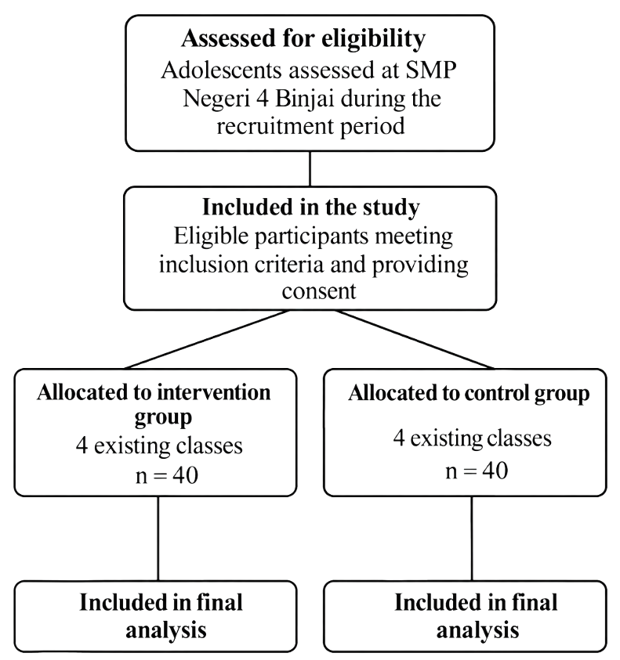
Figure 1. Participant flow diagram.
2.4. Intervention
The intervention was a single 60-minute structured reproductive health education session focused on STI prevention. Content covered definition and types of STIs, causes, modes of transmission, signs and symptoms, risk factors, complications, prevention strategies, responsible reproductive health behaviors, and the importance of seeking care when indicated.
Delivery combined interactive lecture, visual presentation, group discussion, question-and-answer, and take-home leaflets. The session was facilitated by a trained health educator following a standardized module and session guide to ensure consistency of content, sequence, media, and duration across intervention classes. Approximate timing was: 10 min introduction and pretest, 30 min presentation, 15 min discussion, and 5 min key-message reinforcement.
Control-group classes continued to receive usual health information available at the school and did not receive the structured session until after posttest completion (ethical provision of materials). Attendance and session completion were recorded by the research team.
2.5. Outcomes and variables
The primary outcome was the change in STI-prevention knowledge score from pretest to immediate posttest. The secondary outcome was the corresponding change in attitude score. These were proximal, short-term educational outcomes. The exposure was study-group allocation: structured reproductive health education or the usual-information control condition. Age, sex, and previous exposure to reproductive health information were summarized as descriptive participant characteristics. For each outcome, the change score was calculated as the posttest score minus the pretest score. The stand was the unadjusted between-group difference in mean change scores, calculated as the intervention-group mean change minus the control-group mean change. These comparisons did not adjust for baseline scores or demographic characteristics and did not account for class-level clustering.
No biological STI outcomes, STI incidence, or objectively observed sexual behaviors were assessed. Therefore, changes in knowledge and attitudes were considered proximal educational outcomes and were not interpreted as evidence of reduced STI incidence or reduced risky sexual behavior.
2.6. Study instruments
Data were collected using a structured questionnaire consisting of sections on respondent characteristics, STI knowledge, and attitudes toward STI prevention. The knowledge questionnaire covered the definition, types, causes, modes of transmission, signs and symptoms, risk factors, complications, and prevention of STIs. Each response was scored according to a predefined answer key, and the individual item scores were summed to obtain the total knowledge score.
The attitude instrument consisted of statements using a Likert scale to assess respondents' attitudes toward STI prevention behaviors.
The content validity of the questionnaire was assessed by five experts with expertise in adolescent reproductive health, nursing, midwifery, and health education. The item-level content validity index (I-CVI) ranged from 0.80 to 1.00, while the scale-level content validity index based on the average method (S-CVI/Ave) was 0.94, indicating satisfactory content validity. Reliability testing was conducted among 30 adolescents with characteristics similar to those of the study population who were not included in the main study. The knowledge instrument demonstrated a Cronbach's alpha of 0.87, while the attitude instrument demonstrated a Cronbach's alpha of 0.91, indicating good internal consistency. These results supported the use of both instruments in the main study. The same instrument was used for the pretest and posttest, with standardized administration procedures to minimize measurement variability.
2.7. Study procedures
The study began with a preparation phase that included protocol development, preparation or adaptation of the educational materials, instrument preparation, instrument testing, coordination with the study-site administrators, and training of personnel involved in data collection.
Eligible participants received an explanation of the study objectives, procedures, potential benefits, possible discomforts, confidentiality measures, and their right to refuse or withdraw from participation without consequences. After consent was obtained, participants completed the pretest to assess baseline knowledge and attitudes.
The intervention group then received reproductive health education according to the established protocol, whereas the control group continued to receive routine information available at the study setting. After completion of the intervention, both groups completed the posttest using the same instrument immediately after the educational session.
The researchers ensured that questionnaires were completed independently and under relatively standardized conditions. The time interval between completion of the intervention and administration of the posttest was minimized and was standardized across groups as far as operationally feasible.
Intervention adherence, participant attendance, session completion, and participant losses during the study were recorded and reported.
2.8. Bias control and limitations of inference
Selection bias was minimized by applying uniform eligibility criteria and by reporting baseline sociodemographic and outcome characteristics. Nonetheless, non-random allocation at the class level leaves residual confounding possible; nonsignificant baseline differences were not interpreted as evidence of group equivalence.
Information bias was addressed through validated instruments, standardized administration procedures, uniform instructions, and independent questionnaire completion without researcher prompting. Immediate post-session administration of the same instrument, however, may have introduced pretest sensitization, item recall, and content overlap with the educational material.
Intervention fidelity was supported by a standardized module, fixed sequence of topics, identical media, and a session guide applied across all intervention classes. Contamination was limited by conducting intervention and control activities separately and by withholding educational materials from the control group until after the posttest. These safeguards could not eliminate differences in participant expectations or external information exposure.
All 80 participants completed both assessments, resulting in zero attrition. Because allocation occurred by class, observations within the same class are potentially correlated. The primary analyses treated individuals as independent units and did not adjust for clustering, baseline scores, or covariates; consequently, standard errors may be underestimated and confidence intervals overly precise. No cluster-adjusted or mixed-effects sensitivity analyses were available to assess robustness of the reported associations.
2.9. Data analysis
Data were analyzed using IBM SPSS Statistics version 23. Participant characteristics were summarized as frequencies and percentages, and knowledge and attitude scores as means and standard deviations. Normality was assessed using the Shapiro–Wilk test. Within-group pretest–posttest comparisons used paired-samples t-tests. Between-group comparisons used independent-samples t-tests of individual change scores, calculated as posttest minus pretest scores. Mean differences, 95% confidence intervals, and p-values were reported, with Cohen’s d used to quantify standardized between-group differences in change scores. The comparisons were unadjusted for baseline scores and demographic characteristics and did not account for class-level clustering. All tests were two-sided, with statistical significance set at p < 0.05. Because the individual-level analyses did not account for clustering, confidence intervals and p-values require cautious interpretation. ICC-based design-effect calculations were descriptive and did not constitute a mixed-effects sensitivity analysis.
3.1. Participant characteristics
Eighty participants were analyzed, with 40 in each study group and no reported loss to follow-up. Because allocation occurred through eight existing classes, the nominal sample of 80 does not represent 80 fully independent allocation units. Table 1 summarizes sociodemographic characteristics. The study included 80 participants, with 40 participants in the intervention group and 40 in the control group. Regarding age, the majority of participants were aged 17–18 years (42/80, 52.5%), followed by those aged 15–16 years (22/80, 27.5%) and those aged 19 years (16/80, 20.0%). The age distribution was identical between the intervention and control groups. The sex distribution was also balanced, with 40 male participants (50.0%) and 40 female participants (50.0%) overall. In terms of educational level, 51 participants (63.7%) were categorized as senior high school/equivalent, while 29 (36.3%) were categorized as junior high school/equivalent. These proportions were comparable between the intervention group (65.0% and 35.0%, respectively) and the control group (62.5% and 37.5%, respectively). Regarding previous reproductive health information, 47 participants (58.8%) reported having received such information, whereas 33 (41.3%) reported no previous exposure. The proportions were similar in the intervention group (60.0% and 40.0%, respectively) and the control group (57.5% and 42.5%, respectively).
Table 1. Respondent characteristics by study group.
| Characteristics | Intervention (n=40) | Control (n=40) | Total (n=80) |
| Age (years) | |||
| 15–16 | 11 (27.5%) | 11 (27.5%) | 22 (27.5%) |
| 17–18 | 21 (52.5%) | 21 (52.5%) | 42 (52.5%) |
| 19 | 8 (20.0%) | 8 (20.0%) | 16 (20.0%) |
| Sex | |||
| Male | 20 (50.0%) | 20 (50.0%) | 40 (50.0%) |
| Female | 20 (50.0%) | 20 (50.0%) | 40 (50.0%) |
| Educational level | |||
| Junior high school/equivalent | 14 (35.0%) | 15 (37.5%) | 29 (36.3%) |
| Senior high school/equivalent | 26 (65.0%) | 25 (62.5%) | 51 (63.7%) |
| Previous reproductive health information | |||
| Yes | 24 (60.0%) | 23 (57.5%) | 47 (58.8%) |
| No | 16 (40.0%) | 17 (42.5%) | 33 (41.3%) |
3.2. Baseline knowledge and attitude scores
As shown in Table 2, baseline knowledge and attitude means did not differ statistically in unadjusted individual-level tests (p = 0.202 and p = 0.267, respectively). These tests are descriptive and do not establish baseline equivalence or remove confounding from nonrandomized class allocation.
Table 2. Comparison of baseline knowledge and attitude scores.
| Variable | Intervention (n=40) Mean ± SD | Control (n=40) Mean ± SD | t | p-value |
| Knowledge | 60.01 ± 7.81 | 62.19 ± 7.33 | -1.287 | 0.202 |
| Attitude | 68.02 ± 7.12 | 66.02 ± 8.82 | 1.117 | 0.267 |
3.3. Within-group changes in knowledge
Table 3 shows that the mean knowledge score in the intervention group increased from 60.01 ± 7.81 at pretest to 86.29 ± 12.02 at posttest, representing an increase of 26.28 ± 9.39 points. The paired t-test demonstrated that this increase was statistically significant (p < 0.001). In the control group, the mean knowledge score also increased from 62.19 ± 7.33 to 70.00 ± 10.72, representing an increase of 7.81 ± 8.66 points (p < 0.001).
Table 3. Changes in knowledge scores before and after the intervention.
| Group | Pretest Mean ± SD | Posttest Mean ± SD | Mean Difference ± SD | Paired t | p-value |
| Intervention (n=40) | 60.01 ± 7.81 | 86.29 ± 12.02 | 26.28 ± 9.39 | 17.711 | <0.001 |
| Control (n=40) | 62.19 ± 7.33 | 70.00 ± 10.72 | 7.81 ± 8.66 | 5.706 | <0.001 |
3.4. Within-group changes in attitude
As shown in Table 4, the mean attitude score in the intervention group increased from 68.02 ± 7.12 to 88.20 ± 12.33, with a mean increase of 20.18 ± 9.13 points. The paired t-test indicated a statistically significant improvement (p < 0.001). In the control group, the attitude score increased from 66.02 ± 8.82 to 72.77 ± 11.04, representing an increase of 6.76 ± 5.98 points, which was also statistically significant (p < 0.001).
Table 4. Changes in attitude scores before and after the intervention.
| Group | Pretest Mean ± SD | Post-test Mean ± SD | Mean Difference ± SD | Paired t | p-value |
| Intervention (n=40) | 68.02 ± 7.12 | 88.20 ± 12.33 | 20.18 ± 9.13 | 13.977 | <0.001 |
| Control (n=40) | 66.02 ± 8.82 | 72.77 ± 11.04 | 6.75 ± 5.98 | 7.150 | <0.001 |
3.5. Between-group differences in change scores
The unadjusted mean difference in knowledge change was 18.47 points (95% CI: 14.45-22.49; t = 9.146; p < 0.001; Cohen's d = 2.05). The unadjusted mean difference in attitude change was 13.42 points (95% CI: 9.99-16.86; t = 7.779; p < 0.001; Cohen's d = 1.74) (Table 5). These confidence intervals and p-values treat individuals as independent and may therefore be too precise. The standardized differences are mathematically consistent with the reported change-score means and standard deviations but are unusually large for a single session and are susceptible to immediate recall, pretest sensitization, and measurement overlap with the educational content.
Table 5. Comparison of improvements in knowledge and attitude between groups.
| Outcome | Intervention change, mean ± SD | Control change, mean ± SD | Unadjusted difference in change | 95% CI | t | p-value | Cohen's d |
| Knowledge | 26.28 ± 9.39 | 7.81 ± 8.66 | 18.47 | 14.45–22.49 | 9.146 | <0.001 | 2.05 |
| Attitude | 20.18 ± 9.13 | 6.75 ± 5.98 | 13.42 | 9.99–16.86 | 7.779 | <0.001 | 1.74 |
This quasi-experimental study found that a single 60-minute structured reproductive health education session produced substantially larger immediate gains in STI-prevention knowledge and attitude scores than usual information. The intervention group showed larger immediate gains in knowledge and attitude scores than the control group. The unadjusted between-group differences in change were 18.47 points for knowledge and 13.42 points for attitude. These findings describe short-term responses measured immediately after one 60-minute session. They should not be interpreted as evidence of sustained learning, stable attitude change, safer sexual behavior, or reduced STI incidence [10].
The direction of the findings aligns with a substantial body of evidence that school-based sexuality education improves proximal cognitive and attitudinal outcomes. A recent meta-analysis of school-based programs reported moderate effects on knowledge (Hedges’ g = 0.61) and smaller but significant effects on attitudes (g = 0.36), although heterogeneity was high [13]. Systematic reviews consistently show that well-designed interventions increase knowledge and frequently improve attitudes, while effects on sexual behavior and biological endpoints remain more variable and often non-significant [10,14,15]. In Indonesia, an evaluation of the SETARA comprehensive sexuality education program found that younger adolescents improved their knowledge, gender-equitable attitudes, and communication skills in the short term. These findings support the use of structured, school-based sexuality education programs in this study [16].
In addition, the magnitude of the standardized differences observed here is unusually large for a single session and requires cautious interpretation. Immediate post-test designs are susceptible to pretest sensitization, short-term recall of taught content, and possible overlap between educational material and questionnaire items. Such measurement artefacts can inflate apparent effects; knowledge gains measured immediately after instruction frequently decay substantially within weeks to months [17,18]. Parallel improvements in knowledge and attitude scores are conceptually coherent accurate information can shape risk perception and readiness to adopt preventive behaviors yet the present study measured neither intermediate mechanisms (self-efficacy, perceived norms, behavioral intentions) nor distal behavioral or biological outcomes. Consequently, the findings indicate an educational pathway rather than evidence of reduced STI transmission [12, 19].
Furthermore, the control-group improvements may reflect repeated testing, concurrent information exposure, or other time-related influences. Because allocation occurred by class, shared classroom influences may also contribute to the observed group differences. The reported ICC-based design effects illustrate a possible loss of independent information, however without verified ICC output and a cluster-aware treatment estimate, they cannot demonstrate robustness to clustering [20]. The relationship between the two outcomes is also conceptually important. Knowledge is an essential cognitive determinant that can influence attitudes toward STI prevention, while positive attitudes can strengthen readiness to adopt preventive behaviors [12].
The study has several limitations. Nonrandom allocation permits residual confounding, and individual-level tests do not account for class-level clustering. With only eight classes, cluster-aware inference requires particular attention to small-sample methods. Availability-based recruitment and a single reported site limit precision and generalizability. Immediate reuse of the same questionnaire may introduce pretest sensitization, item recall, and overlap between taught content and test items. Knowledge and attitude scores are proximal outcomes; neither sustained retention nor behavioral or biological outcomes was measured. The age, educational-level, and setting descriptions require verification before the population can be defined reliably. Adjusted and cluster-aware estimates are needed to evaluate whether the reported associations persist under an appropriate analysis.
A single structured reproductive health education session was associated with larger immediate gains in STI-prevention knowledge and attitude scores than usual information in the reported individual-level comparisons. These estimates are unadjusted and do not account for class-level clustering, so their confidence intervals and p-values should be interpreted cautiously. The large standardized differences may partly reflect immediate recall or measurement overlap. The findings warrant further evaluation but do not establish sustained learning, preventive behavior change, or reduced STI incidence. Interpretation depends on confirmation of the recruitment setting and participant characteristics, and on baseline-adjusted and cluster-aware analyses. Future studies should include more classes and delayed follow-up to assess retention.
The authors would like to express their sincere gratitude to the Government of Binjai City, particularly the Principal of SMP Negeri 4 Binjai, for the support, permission, and cooperation provided throughout the implementation of this study. The authors also extend their appreciation to all students who participated in the study for their willingness, time, and active involvement during the data collection and educational activities. The authors are also grateful to all individuals who contributed to the preparation, implementation, and completion of this research.
There is no specific grant from any funding agency.
The authors have no conflicts of interest.
Ethical approval was obtained from the Health Research Ethics Committee of the Health Workforce Education and Training Association Health Scientific Progress, under Ethical Approval No. 039/PROMISE/KEPK/V/2026. The study was conducted in accordance with the ethical principles of the Declaration of Helsinki. All participants were informed about the study objectives and procedures and provided informed consent before participation. Confidentiality and anonymity of participants' data were maintained throughout the study.
The data that support the findings of this study are available in the article. Further details may be obtained from the corresponding author upon request.
AI tools were used for language editing, grammar correction, and improving the readability and structure of this manuscript in accordance with the journal's policy.

This work is licensed under a
Creative Commons Attribution 4.0 International License
.
You are free to share and adapt this material for any purpose, even commercially, as long as you give appropriate credit.
 access