J. Biosci. Public Health. 2026; 2(4)

First and Corresponding Author
https://orcid.org/0000-0003-4848-6516
Affiliations:
Department of Anatomy, Histology and Physiology, Faculty of Animal Science and Veterinary Medicine, Sher-e- Bangla Agricultural University, Dhaka -1207, Bangladesh.
Coauthor
https://orcid.org/0009-0006-0873-9020
Affiliations:
Department of Anatomy, Histology and Physiology, Faculty of Animal Science and Veterinary Medicine, Sher-e- Bangla Agricultural University, Dhaka -1207, Bangladesh.
Coauthor
https://orcid.org/0009-0000-6183-9019
Affiliations:
Department of Anatomy, Histology and Physiology, Faculty of Animal Science and Veterinary Medicine, Sher-e- Bangla Agricultural University, Dhaka -1207, Bangladesh.
Coauthor
ORCID: https://orcid.org/0009-0009-1953-7741
Affiliations:
Department of Animal Nutrition, Genetics and Breeding, Faculty of Animal Science and Veterinary Medicine, Sher-e- Bangla Agricultural University, Dhaka -1207. Bangladesh.
Neonatal calves often face health challenges like diarrhea, which can slow growth, but probiotics added to feed may help improve calf physiology. This experiment assessed the physiological effects of probiotics on health performance and haemato-biochemical parameters related to the prevention and control of diarrhea in neonatal Sahiwal calves. A total of 30 local shahiwal crossbreed female calves aged 1 to 3 days whose initial body weights were more or less similar were allocated into two experimental groups. The control group (n=15) was fed normal milk without additives, and the probiotic group (n=15) was fed normal milk with probiotic (4 g/day) throughout the 60-days trial period. Body weight was measured at birth and thereafter at 15 days interval up to 8 weeks of age. Blood samples from the experimental calves were collected by jugular venipuncture for hemato-biochemical analysis. Fecal consistency was observed and recorded daily throughout the trial period. Results showed that calves in the control and probiotic groups had significantly (P<0.05) higher initial body weights, but probiotics had no significant (P<0.05) effect on any of the hemato-biochemical traits measured. Moreover, Probiotics reduced the incidence of diarrhea and were effective after two weeks of application, possibly due to improved intestinal bacterial flora in calves supplemented with probiotics. It was concluded that adding probiotics to normal milk can increase daily weight gain and feed conversion efficiency and reduce the incidence of neonatal diarrhea.
Calf mortality is a major problem on dairy farms worldwide. Diarrhea is the most common causes of death among calves. During the pre-weaning period, young calves are vulnerable to infectious pathogens that primarily damage the intestine [1]. It remains an overwhelming disease all over the world mainly in calves less than three months of age [2]. Concerns remain that using antibiotics as feed additives may contribute to increased bacterial antibiotic resistance, and some countries have restricted certain antibiotic types. Antibiotic use can destroy both desirable and harmful species, whereas adding probiotics to the starter diet [3] or to milk [4] improved feed intake, daily weight gain, and faecal score compared with the control group.
Probiotics have multiple beneficial effects, including improved rumen microbial ecology [5], nutrient digestibility [6], nutrient absorption and feed conversion rate [7], haematological parameters [8], and decreased cholesterol [9], leading to improved performance in farm animals. So, feeding these nutrients might promote the growth of gut bacteria and improve the microbial profile in the gut [10]. Probiotics can improve digestion and nutrient absorption and strengthen calves’ immune systems [11, 12]. Probiotics are defined as “live microbial feed supplements” that beneficially affect the host by improving intestinal microbial balance. They provide a proper alternative to the traditional practice of using antibiotics as a treatment [13] defined probiotics as live bacteria intended to colonize the large intestine and confer physiological health benefits to the host. Probiotic efficacy depends not only on the inclusion level but also on strain characteristics and product quality [14, 15]. Antibiotics, used as growth promoters and medicines, have been widely used in the dairy sector for more than 50 years, but in some parts of the world, legislation has promoted the search for alternatives. Therefore, Probiotics are one such alternative, considered emerging, safe, and viable for improving farm animal performance [15], and are also considered an alternative as non-antibiotic growth promoters become more popular in the dairy industry [16]. Neonatal calves’ diarrhea is a major cause of economic loss to the dairy farmers [17]. It is the leading cause of death in dairy heifer and beef calves aged less than four months. Financial losses occur not only from calves’ mortality, but also from the cost of medication and labor needed to treat and care for the sick calves [17]. This has led scientists to investigate alternative supplements that act like antibiotics to improve animal production [15].
However, no comprehensive study has been undertaken in Bangladesh to evaluate the efficacy of probiotic supplementation for preventing and controlling neonatal diarrhea in Sahiwal calves. In this regard, probiotics could be a potential supplement to improve the health status and immunity of newborn calves.
2.1. Experimental design
The experiment was carried out on a private dairy farm in Savar, Dhaka, and analyzed at the Physiology Laboratory of the Department of Anatomy, Histology and Physiology, Faculty of Animal Science and Veterinary Medicine, Sher-e-Bangla Agricultural University, Dhaka-1207, Bangladesh. A total of 30 local Shahiwal crossbred female calves aged 1 to 3 days whose initial body weight more or less similar were allocated into two (n=15) experimental groups including the control group, which were fed normal milk without no additives and probiotic group were fed normal milk with probiotic (Protexin® Boost) @ 4 g per day in the morning. Normal milk was offered twice a day whereas clostrum and water was offered adlibitum. Calves were not administered any vaccination and were housed under similar management conditions in separate rows on the concrete-floored, well-ventilated and properly managed shed throughout the 60-days trial period.
2.2. Collection and processing of probiotics
The probiotic (Protexin* Boost), which is commercially available, was collected from the market in Dhaka city. Protexin® Boost was used as a probiotic in this experiment, mixed with normal milk. This probiotic included Lactobacillus plantarum, Lactobacillus acidophilus, Enterococcus faecium, yeast Candida parapsilosis, and Aspergillus oryzae (Table 1). A minimum of 2×10⁹ colony forming units (CFU)/G was present in these probiotics (protexin® Boost).
Table 1. Live viable strains of naturally occurring microorganism.
| Bacteria | CFU/gm | Active ingredient |
| Lactobacillus plantarum | 1.26x10⁹ | 6.3% |
| Lactobacillus acidophilus | 2.06x10⁸ | 10.3% |
| Enterococcus faecium | 5.32x10⁷ | 29.00% |
| Mold | CFU/gm | Active ingredient |
| Candida pintolopessi | 5.32x10 | 2.66% |
| Aspergillus oryzae | 5.32x10 | 2.66% |
2.3. Growth rate analysis
Body weight was measured at birth and thereafter at 15-day intervals up to 8 weeks of age before morning feeding, using withers height, body length from shoulder to pin bone, and heart girth behind the shoulders, respectively.
2.4. Hematological analysis
Five ml of blood samples from the calves of both treated and untreated groups were collected by jugular venipuncture. Immediately after collection, the samples were transferred to sterile screw-capped tubes containing EDTA for hematology. Then the hematological parameters like i) tRBC (106/ml), ii) tWBC (103/ml), iii) Platelets (103/ml), iv) PCV (%), v) Hb (gm%) were analyzed by using the automated hematology analyzer Sysmex XN-2000.
2.5. Biochemical analysis
The collected blood samples were transferred into tubes containing lithium heparin for serum biochemistry. Then the biochemical parameters like - i) Aspartate transferase (IU/L), ii) Alanine transferase (IU/L), iii) Blood urea nitrogen (mg/dl), iv) Glucose (mg/dl), v) Total protein (gm/dl), vi) Albumin (gm/dl) were analyzed by using the automatic biochemical analyzer Vitros 5600 (J&J)/Beckman Coulter AU480.
2.6. Fecal analysis
Calf diarrhea was evaluated using the fecal score and recorded according to [18]. For fecal fluidity, scoring was as follows: 1 = normal, 2 = soft, 3 = thin, 4 = watery during the experimental period.
2.7. Statistical analysis:
The obtained data were loaded and stored in an Excel spreadsheet. The data were then analyzed using IBM SPSS Statistical Package Version 22, followed by one-way ANOVA. All results are expressed as means ± standard error (SE), and a probability P<0.05 or less was considered statistically significant.
3.1. Evaluation of probiotic on growth performance
The results in Table 2 showed that the initial body weights of the experimental calves in the control and probiotic groups were 23.60 (1.0 kg) and 23.40 (1.0 kg), respectively. Calves' final body weights at the end of the experiment in the control and probiotic groups were 38.12 (0.32 kg) and 46.08 (0.26 kg), respectively. The probiotic treated group has significantly (P<0.05) higher numerical values than the control at the end of the experiment. Average daily gain was 0.42 kg in the probiotic group and 0.28 kg in the control group. Calves that received probiotic with whole milk had significantly (P<0.05) higher average body weight and average daily gain than calves in the control group.
Table 2. Evaluation of probiotic on growth performance in calves.
| Experimental groups | Pre-treatment body weight (kg) | Post-treated body weight (kg) | |||
| Day 1 | Day 15 | Day 30 | Day 45 | Day 60 | |
| Control group | 23.60 ± 1.0 | 27.20 ± 0.12 | 30.16 ± 0.45 | 34.23 ± 0.60 | 38.12 ± 0.32 |
| Probiotic group | 23.40 ± 1.0 | 29.34 ± 2.4 | 35.64 ± 0.68 | 41.68 ± 0.23 | 46.08 ± 0.26 |
Data were presented as mean ± standard error. Values followed by different groups in the same row differ significantly (p<0.05).
3.2. Evaluation of probiotic on hematological parameters
Regarding hematological parameters in the probiotic treated calves and their control, mean values of both of them are shown in (Table 3). The values of total erythrocyte count, hemoglobin concentration, and packed cell volume were slightly higher but did not differ significantly (P<0.05). Total leukocyte and platelet counts were within normal physiological ranges. In this experiment, the probiotic supplementation had no statistically significant (P<0.05) effects on any of the measured hematological traits.
Table 3. Evaluation of probiotic on hematological parameters in calves.
| Hematological parameters | Control group (n = 15) | Probiotic group (n = 15) |
| Total erythrocyte count ((M/µl)) | 7.21 ± 0.06 | 8.89 ± 0.09 |
| Total leukocyte count ((K/µl)) | 8.48 ± 0.05 | 8.92 ± 0.06 |
| Platelets count ((K/µl)) | 450.2 ± 2.18 | 451.3 ± 1.45 |
| Hemoglobin concentration (Gm%) | 10.31 ± 0.04 | 11.80 ± 0.07 |
| Packed cell volume (%) | 35.12 ± 0.05 | 36.28 ± 0.08 |
Data were presented as mean ± standard error. Values followed by different groups in the same row differ significantly (p<0.05).
3.3. Evaluation of probiotic on biochemical parameters
Regarding biochemical parameters in the probiotic treated calves and their control, mean values of both of them are shown in (Table 4). All parameter values were within normal physiological ranges. In this experiment, the probiotic supplementation had no statistically significant (P<0.05) effects on any of the measured biochemical traits.
Table 4. Evaluation of probiotic on biochemical parameters in calves.
| Biochemical parameters | Control group (n = 15) | Probiotic group (n = 15) |
| Aspartate transferase (IU/L) | 82.23 ± 0.02 | 82.75 ± 0.03 |
| Alanine transferase (IU/L) | 60.48 ± 0.04 | 60.52 ± 0.02 |
| Blood urea nitrogen (mg/dl) | 23.40 ± 0.01 | 23.89 ± 0.03 |
| Glucose (mg/dl) | 73.45 ± 0.02 | 73.88 ± 0.04 |
| Total protein (gm/dl) | 7.34 ± 0.05 | 7.78 ± 0.02 |
| Albumin (gm/dl) | 5.61 ± 0.02 | 6.08 ± 0.03 |
Data were presented as mean ± standard error. Values followed by different groups in the same row differ significantly (p<0.05).
3.4. Evaluation of probiotic on diarrheal frequency
Calf diarrhea was assessed using the fecal score during the 30-day pre-weaning period. Significantly, the probiotic group showed no signs of diarrhea after week two, whereas diarrhea occurred in calves in the unsupplemented group throughout the experiment. There was a significant statistical difference in fecal scores between the groups after two weeks, where the fecal score became constant in the probiotic-treated group and never exceeded the normal value (Figure-1).
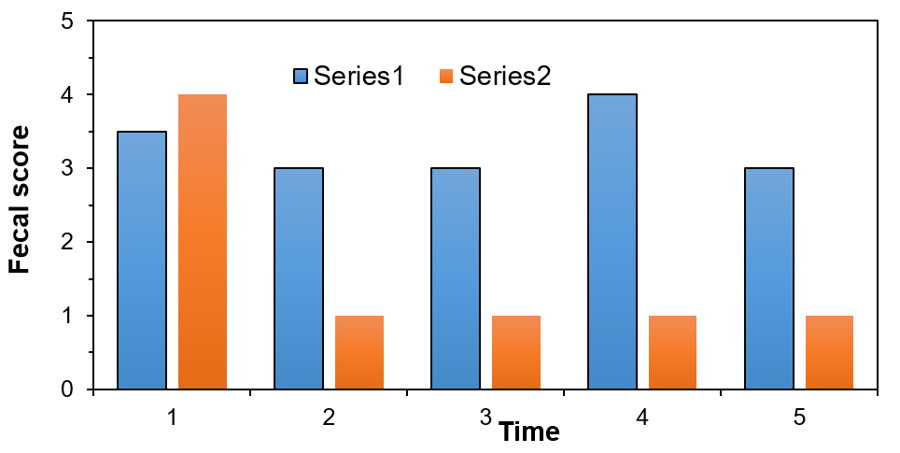
Figure 1. Series -1 indicate control group and series-2 indicate probiotic group. Mean fecal score of neonatal calves supplemented with or without probiotics. Calve diarrhea was evaluated using the fecal score and recorded according to [18].
4.1. Evaluation of probiotic on growth performance in calves
There was proper improvement in the general performance of calves. These positive effects may be due to reduced multiplication of harmful gut bacteria, resulting from improved gut conditions and enhanced nutrient utilization through probiotic action [19]. This positive effect was similar to the [20] results, as their study assessed calves up to 25 days of age. Moreover, [21] stated that the groups with probiotic and antibiotic in their study had significantly higher body weight than the control group which is also reliable with [22] results, who also performed different experiments in the first month of birth and also, [23] reported a significant difference in the growth of the probiotic group between 30 and 45 days. The increase in both body weight gain and disease resistance places the young calf in a favorable position to continue gaining body weight and be better prepared to resist diarrheal pathogens. Different mechanisms of probiotic action have been described [24], which state that probiotics compete for nutrients and produce antibacterial compounds in the intestine, allowing them to occupy specific niches of the intestinal mucosa and activate the innate immune system. The contribution of both mechanisms is related directly to the probiotic strain type and the feed consumed by the calves. Improved feed utilization and consequent improvements in body weight gain are the final consequences of probiotic action.
4.2. Evaluation of probiotic on haemato-biochemical parameters
In the present study, the hematological and biochemical profile showed that all values were within the normal physiological range, and the probiotics had no significant effect on any of the hematological and biochemical traits measured. This was similar to the findings of [25-27], which reported no variation in hematological and biochemical parameters between probiotic-treated calves and the control group throughout their studies.
4.3. Evaluation of probiotic on diarrheal frequency
However, there was a significant difference in fecal score between the probiotic group and the control after two weeks of the experiment. Fecal scores became stable in the probiotic-treated group and didn’t exceed normal levels, indicating that probiotics reduced the incidence of diarrhea and were effective after two weeks of application. This may be due to improved intestinal bacterial flora in calves supplemented with probiotics. This was similar to (20, 24, 28)]. In contrast, found no probiotic-induced reduction in diarrhea occurrence; [29-31] reported that, for diarrhea and fecal scoring, calves fed probiotics were superior to the control group, similar to the present study. This may be because lactic acid bacteria can stimulate the immune response against pathogenic bacteria and counter the negative effects of illness [24]. Also, stated that calves supplemented with probiotics were superior with respect to diarrhea than the control groups and concluded that probiotics supplementation before weaning could boost calf health and reduce mortality and cost of buying drugs [31]. The same conclusion was reported by for piglets and calves. This finding agrees with the present study [32].
In the present study, using probiotics in whole milk can increase daily weight gain and feed conversion efficiency and reduce the incidence of diarrhea in neonatal calves. The hemato-biochemical profile showed that several values were numerically different within groups, however no significant effect on any of the traits measured. It is recommended that probiotics should be used in animal production in order to reduce the use of antibiotics in animal industry, which has negative effect on the consumer’s health. Further studies should be carried out using a large number of animals to assess the effect of probiotics on animal growth performance and the health condition of neonatal calves.
The author would like to cordially thank the respected farm members and the Physiology Laboratory at Sher-e-Bangla Agricultural University, Dhaka, for the technical facilities and support for this research work
The authors declare that they received no financial support or funding for the research.
The authors have no conflicts of interest.
Sajibul Hasan: Conceptualization, methodology, formal analysis, writing original draft, review and editing. Md. Mosharaf Hossain: Investigation, formal analysis, review and editing. Nazmunnahar Nisa: Methodology, investigation, data collection. Md. Abdur Raihan Ratul: Investigation, data collection, validation and writing.
The experimental procedures of this study were approved by the Local Animal Care and Ethics Committee of Sher-e- Bangla Agricultural University (ASVM/SAU/07/2023).
The data that support the findings of this study are available in the article. Further details may be obtained from the corresponding author upon request.
The AI tools were not used to generate scientific content, interpret data or draw conclusions. The authors performed all literature selection, data interpretation, and final manuscript preparation and accept full responsibility for the accuracy and integrity of the work.

This work is licensed under a
Creative Commons Attribution 4.0 International License
.
You are free to share and adapt this material for any purpose, even commercially, as long as you give appropriate credit.
 access