J. Biosci. Public Health. 2026; 2(3)

First Author
https://orcid.org/0000-0003-3352-9827
Affiliations:
Fertilizer division, Advanced Chemical Industries PLC (ACI), Dhaka, Bangladesh
Coauthor
https://orcid.org/0009-0002-0134-9688
Affiliations:
Fertilizer division, Advanced Chemical Industries PLC (ACI), Dhaka, Bangladesh
Coauthor
https://orcid.org/0009-0005-7110-4055
Affiliations:
Fertilizer division, Advanced Chemical Industries PLC (ACI), Dhaka, Bangladesh
Coauthor
https://orcid.org/0009-0005-7104-2843
Affiliations:
Albany College of Pharmacy and Health Sciences, 106 New Scotland Avenue, Albany, Newyork 12208, United States of America
Corresponding Author *
https://orcid.org/0000-0002-9788-0766
Affiliations:
Department of Biochemistry and Molecular Biology, Faculty of agriculture, Hajee Mohammad Danesh Science and Technology University, Dinajpur 5200, Bangladesh
Corresponding Author *
https://orcid.org/0000-0002-9788-0766
Affiliations:
Department of Biochemistry and Molecular Biology, Faculty of agriculture, Hajee Mohammad Danesh Science and Technology University, Dinajpur 5200, Bangladesh
Calcareous soils in coastal lowland regions are typically deficient in nitrogen (N) and available phosphorus (P). Moreover, these agro-ecosystems are regularly affected by tidal activities. Therefore, this study evaluated the effect of bio-organic fertilizer application without inorganic phosphorus and with a 30% reduction in nitrogen on the yield and yield attributes of rice in a coastal area of Bangladesh. A field experiment was conducted during the Rabi season using a randomized complete block design (RCBD) with five treatments and three replications. Each plot measured 20 m² with a spacing of 20 cm × 20 cm. The treatments included: T1 = 100% chemical fertilizer (control); T2 = 70% N without inorganic P + recommended fertilizers; T3 = 70% N without inorganic P + K and S + bio-organic fertilizer at 500 kg ha⁻¹; T4 = similar to T3 with bio-organic fertilizer at 750 kg ha⁻¹; and T5 = similar to T3 with bio-organic fertilizer at 1000 kg ha⁻¹. Results demonstrated that bio-organic fertilizer significantly improved growth and yield attributes. Treatment T4 produced the highest effective yield (6.66 MT ha⁻¹), representing an 11.09% increase over the control. Although T5 showed the highest numerical yield, T4 was identified as the optimal treatment due to its comparable productivity at a lower input cost and the highest benefit-cost ratio. The findings suggest that integrating bio-organic fertilizer at 750 kg ha⁻¹ can effectively replace inorganic phosphorus and reduce nitrogen use by 30% without compromising yield. This strategy improves soil biological activity and supports sustainable nutrient management. Overall, the approach offers a cost-effective and environmental solution for rice cultivation in Bangladesh and similar agroecological systems.
Rice (Oryza sativa L.) is the most critical staple food crop globally, providing the primary caloric intake for more than half of the world's population [1, 2]. To maintain global food security for a growing population, rice yields must increase by approximately 40% by 2030 [3]. Currently, stable production relies heavily on the application of essential macronutrients, particularly nitrogen (N) and phosphorus (P), which are the primary limiting factors for crop growth in over 50% of the world’s cultivable soils [4, 5].
While chemical fertilizers have historically driven productivity gains, their use is characterized by significant inefficiency; it is estimated that only about 20% of applied N and P is actually absorbed by the rice plant [5]. The remaining nutrients are lost to the environment, leading to severe ecological consequences such as the eutrophication of water bodies, soil degradation, and increased greenhouse gas emissions [6, 7]. Notably, flooded rice systems are a major source of atmospheric methane, accounting for roughly 50% of global cropland emissions [8]. Furthermore, excessive chemical inputs can suppress beneficial soil microorganisms and essential pollinators, further compromising the long-term resilience of agricultural ecosystems by contaminating aquatic environments [7, 9].
In response to these challenges, bio-organic fertilizers and plant growth-promoting bacteria have emerged as sustainable alternatives. These biological inputs enhance nutrient cycling through mechanisms such as biological nitrogen fixation, phosphate solubilization, and the production of phytohormones like auxins and gibberellins [10-15]. In particular, the application of BoF can improve soil organic carbon by 6% to 13% compared to synthetic treatments and significantly increase microbial biomass carbon [16, 17].
The integration of specific PGPB strains, such as Bacillus and Paenibacillus spp., has demonstrated the potential to maintain high yields while reducing synthetic fertilizer requirements. For instance, recent field trials have shown that bio-organic formulations can supplement at least 30% of nitrogen requirements and potentially eliminate the need for triple superphosphate entirely [17]; her studies suggest that probiotic bacteria like Paraburkholderia and Delftia can reduce the overall chemical fertilizer requirement by up to 50% without sacrificing yield [18]. Although several studies have demonstrated the benefits of plant growth-promoting bacteria and bio-organic fertilizers in rice cultivation, limited information is available regarding the complete replacement of inorganic phosphorus combined with reduced nitrogen input under coastal agroecosystems of Bangladesh [17, 19].
This study was therefore conducted to evaluate whether a bio-organic fertilizer developed from locally isolated PGPB can maintain or enhance rice productivity while eliminating inorganic P fertilizer and reducing N application by 30%. We hypothesized that an appropriately dosed BoF would compensate for the reduced chemical inputs through improved nutrient mobilization and plant growth promotion, offering a sustainable and economically viable strategy for rice cultivation in resource-constrained coastal environments.
2.1. Experimental site and climate
The field experiment was conducted randomly selected Mirjagonj, Patuakhali, located in the southern coastal region of Bangladesh as a part of a pilot test. The experimental site belongs to the Ganges Tidal Floodplain under Agro-Ecological Zone (AEZ) 13. The area is characterized by medium- to high-elevation land with predominantly clay loam soils. These calcareous soils are generally deficient in nitrogen (N) and available phosphorus (P). The site is also influenced by regular tidal activities typical of lowland coastal ecosystems.
AEZ 13 is considered suitable for rice cultivation under the humid tropical monsoon climate of Bangladesh, which is characterized by high annual rainfall, warm temperatures, and distinct wet and dry seasons. The relative humidity in the region generally ranges from 70% to 84%. These environmental conditions are favorable for rice cultivation during both the rainfed Aman and irrigated Boro seasons.
2.2. Formulation of bio-organic fertilizer
The bio-organic fertilizer was developed and supplied by the Soil Microbiology Laboratory, Bangladesh Rice Research Institute (BRRI), Gazipur. It was a solid formulation with approximately 15–20% moisture content and a maximum particle size of 2 mm. The fertilizer consisted of 79.5% biodegradable kitchen and vegetable waste collected from local markets, 15% rice husk biochar (chita-dhan), and 5% rock phosphate. A consortium of locally isolated, effective plant growth-promoting bacteria (0.5–1% w/w) was incorporated during composting. The bacterial strains included Bacillus mycoides, Bacillus subtilis, Bacillus pumilus, Bacillus cereus, Proteus sp., Paenibacillus polymyxa, and other Paenibacillus spp. These strains are known for nitrogen fixation, phosphate solubilization, and indole-3-acetic acid (IAA) production. The bacterial inoculum was multiplied in molasses-based broth before mixing with the organic substrate, following the method described earlier [17].
In this study, the final product contained 250 g kg⁻¹ organic carbon, 10.4 g kg⁻¹ total N, and 10.4 g kg⁻¹ total P, along with appreciable amounts of potassium, sulfur, and zinc. It had a neutral pH (7.2) and low heavy metal content, ensuring environmental safety. The phosphorus supplied by the bio-organic fertilizer (at 500–1000 kg ha⁻¹) was sufficient to fully substitute the recommended inorganic triple superphosphate (TSP) dose for one rice crop.
2.3. Experimental design and crop management
A field experiment was laid out in a randomized complete block design (RCBD) with five treatments and three replications. Individual plot size was 5 m × 4 m (20 m²). Thirty-five-day-old seedlings of a suitable rice variety were transplanted in March 2023. Standard crop management practices were followed. Weeds were removed manually at 30 and 60 days after transplanting (DAT). Supplemental irrigation was provided as needed to maintain appropriate soil moisture, particularly during dry periods.
2.4. Fertilizer application
Fertilizer rates were based on the Fertilizer Recommendation Guide (FRG, 2012) of Bangladesh. The recommended doses for the control treatment were: urea 300 kg ha⁻¹ (adjusted to N basis), triple superphosphate (TSP) 120 kg ha⁻¹, muriate of potash (MoP) 180 kg ha⁻¹, gypsum 65 kg ha⁻¹, and mono-zinc sulfate 7.5 kg ha⁻¹.
The treatments were as follows:
T1 (Control): 100% recommended chemical fertilizers (full N, P, K, S, and Zn).
T2: 70% recommended N + 0% inorganic P + 100% K, S, and Zn.
T3: 70% recommended N + 0% inorganic P + 100% K, S, and Zn + bio-organic fertilizer @ 500 kg ha⁻¹.
T4: 70% recommended N + 0% inorganic P + 100% K, S, and Zn + bio-organic fertilizer @ 750 kg ha⁻¹.
T5: 70% recommended N + 0% inorganic P + 100% K, S, and Zn + bio-organic fertilizer @ 1000 kg ha⁻¹.
All basal fertilizers (except urea) and the bio-organic fertilizer were applied during final land preparation. Urea was top-dressed in three equal splits at basal, active tillering, and panicle initiation stages. Inorganic TSP was omitted in T2-T5 and replaced by the bio-organic fertilizer, which supplied an additional 5.2, 7.8, and 10.4 kg P ha⁻¹ in T3, T4, and T5, respectively. Full recommended doses of K and S were applied uniformly across all treatments.
2.5. Data collection and analysis
Data on growth and productivity were recorded at vegetative and reproductive stages. Panicle length (cm), 1000-seed weight (gm), and grain yield were determined by standard procedure. Observations were recorded from five randomly selected plants per plot. Yield attributes were recovered after harvesting time. The harvested crop was dried and threshed manually by plot. All agronomic practices were kept uniform for all treatments. Grain yields were recorded from 10 m2 of each plot and converted to MT ha-1. Data were analyzed statistically. In each column, means followed by common letter(s) do not differ significantly at the 5% level by DMRT.
3.1. Growth attributes of rice by bio-organic fertilizer application
Growth attributes, such as plant shoot length (cm), shoot fresh weight (g), root fresh weight (g), and number of effective tillers, were significantly influenced at both the vegetative and reproductive stages as a result of applying different doses of bio-organic fertilizer (Tables 1 and 2).
At the vegetative stage, the tallest plant (66.333 cm) was observed in the T4 treatment, which was significantly taller than the control plant but was not statistically different from the T5 treatment.
A significant effect of treatments on shoot fresh weight was observed at 40 DAT. The highest fresh shoot weight (61.667 g) was observed in the T4 treatment, which was statistically similar to T5 but significantly different from T1 and T2. The highest root fresh weight was observed in the vegetative stage at T4 (19.26 g). This observation is similar to our previous report where the highest shoot and root dry weights in plants were treated with beneficial bacteria [14, 15]. Additionally, the highest number of effective tillers and the highest 100-grain weight significantly increased rice grain yield by 35% compared to the control treatment [15].
Table 1. Effects of growth attributes by Bio-organic fertilizer application on rice at 40 DAT.
| Treatments | At 40 DAT | |||
| Shoot length (cm) | Shoot fresh weight (gm) | Root fresh weight (gm) | Number of effective tillers | |
| T1 (Control) | 60.667 AB | 37.400 BC | 13.833 BC | 17.833 B |
| T2 | 56.667 C | 23.867 C | 10.300 C | 10.167 C |
| T3 | 64.333 B | 45.233 B | 16.733 B | 20.333 AB |
| T4 | 66.333 A | 61.600 A | 19.267 A | 22.667 A |
| T5 | 65.667 A | 59.267 A | 18.433 A | 21.967 A |
| P | 0.0240 | 0.0005 | 0.0915 | 0.0000 |
| CV (%) | 4.28 | 19.46 | 24.03 | 4.84 |
At the reproductive stage, plant shoot length increased gradually with bio-organic fertilizer application compared to the control, with the tallest plant (99.333 cm) in T4, which was statistically similar to T5.
The shoot fresh weight of rice was significantly influenced by the treatment. The highest shoot fresh weight was observed in the T4 treatment (107.73 g), which was not statistically different from that in the T5 treatment. The root fresh weight of rice applied with bio-organic fertilizer tends to be higher than that of the control. The highest root fresh weight was observed at the reproductive stage from T4 (23.833 gm). This might be due to the use of bio-organic fertilizer and the soil, which becomes available to the plant.
It was reported that Bacillus sp. significantly increased plant height, root length, shoot dry weight, root dry weight, and grain yield by up to 11% compared with the control [20]. Similarly, a significant difference in the total number of effective tillers was observed at 40 and 60 DAT across all treatments (Tables 1 and 2).
Table 2. Effects of growth attributes by Bio-organic fertilizer application on rice at 60 DAT.
| Treatments | At 60 DAT | |||
| Shoot length (cm) | Shoot fresh weight (gm) | Root fresh weight (gm) | Number of effective tillers | |
| T1 (Control) | 86.333 B | 90.40 BC | 22.133 AB | 16.000 BC |
| T2 | 73.333 C | 71.93 C | 15.100 C | 14.667 C |
| T3 | 93.667 AB | 98.50 B | 21.300 AB | 17.333 BC |
| T4 | 99.333 A | 107.73 A | 23.833 A | 20.333 A |
| T5 | 98.333 A | 105.53 A | 22.633 A | 19.333 A |
| P | 0.0198 | 0.0093 | 0.1944 | 0.0492 |
| CV (%) | 2.69 | 12.08 | 18.99 | 10.75 |
At the vegetative stage, the maximum number of effective tillers was observed in the T4 treatment (22.667), while T5 yielded results that were statistically similar and non-significant. During the reproductive stage, both T4 and T5 also showed results that were statistically similar and non-significant.
3.2. Yield and yield attribution of rice by bio-organic fertilizer application
The different dosages of treatment affected most yield components, such as panicle length (cm), number of grains per panicle, 1000-grain weight (g/m), and grain yield (MT ha⁻¹), as well as the bio-organic fertilizer. The top panicle length was found from T4 (26.833 cm). There is a statistically similar result shown from T3 and T5 treatments.
Table 3. Effects of Yields attributes of rice by Bio organic fertilizer application at harvesting stage.
| Treatments | At harvesting stage | ||||
| Panicle Length (cm) | Number of Grain/ Panicle | 1000 grain weight (gm) | Yield (MT ha⁻¹) | Yield increases over control (%) | |
| T1 (Control) | 21.400 B | 149.67 B | 13.533 AB | 5.9907 AB | 0.00% |
| T2 | 21.333 B | 137.67 C | 12.933 B | 5.5870 B | -6.72% |
| T3 | 25.533 A | 156.40 AB | 14.000 A | 6.491 AB | 8.36% |
| T4 | 26.833 A | 161.33 A | 14.267 A | 6.6550 A | 11.09% |
| T5 | 26.800 A | 158.67 A | 14.133 A | 6.8223 A | 13.88% |
| P | 0.4195 | 0.0143 | 0.0264 | 0.0694 | |
| CV (%) | 2.92 | 4.98 | 6.41 | 7.67 | |
The number of grains per panicle was significantly higher, with the maximum from T2 (161.33). On the other hand, a maximum grain weight of 1000 (14.267 gm) was recorded in T4, which is statistically equivalent to all treatments except T1 and T2, however numerically higher than the control treatment.
Rice grain yield showed numerical improvement with bio-organic fertilizer treatment. (822 MT ha⁻¹) and (6.655 MT ha⁻¹) were recorded in treatments T4 and T5, respectively, which were numerically higher than the control and T2 (Table 3), but not significantly different at the 5% level. Treatment T1 showed less yield due to the recommended chemical fertilizer application compared to the treated plots, and T2 showed minimum yield due to the absence of inorganic phosphorus fertilizer, which was 5.9907 MT ha⁻¹ and 5.5870 MT ha⁻¹, respectively. Yield increases over control (%) was significantly influenced by the application of bio-organic fertilizer. Treatment T4 numerically increased (11.09%) and treatment T5 (13.88%) over control T1.
Improved plant growth and phosphate uptake have been reported in many crop species following bacterial inoculation. For example, Pseudomonasaeruginosa in rice [21], Bacillus sp. in maize [22], and B. amyloliquefaciens in wheat, maize, and cotton [23] have shown benefits. Panhwar et al. (2011) showed that inoculating rice with the Bacillus sp. PSB9 isolate enhances P uptake, plant biomass, plant height, and root morphology compared to the control [24].
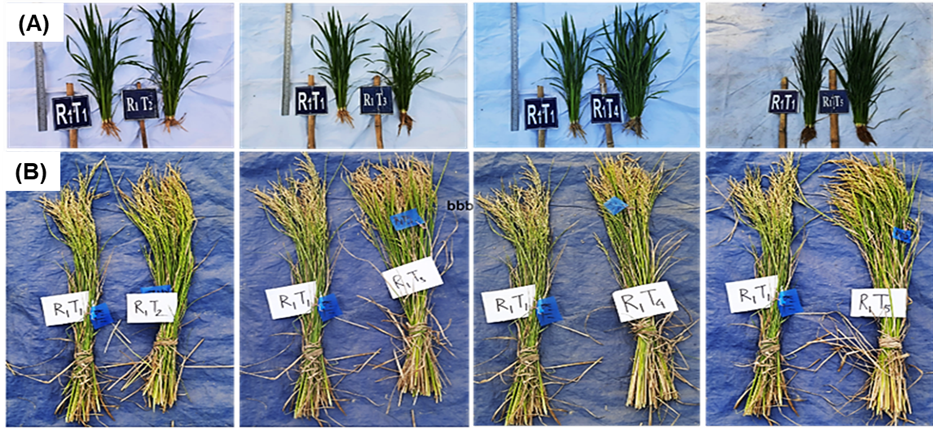
Figure 1. Comparative growth performance of rice plants under different fertilizer treatments; (A) at 40 DAT and, (B) at harvesting stage. Here in inset leveling, R1 means replication whereas T1 to T5 stand for treatment.
Figure 1 illustrates the comparative growth performance of rice plants under different fertilizer regimes at 40 days after transplanting (DAT) (A) and at the harvesting stage (B). Visual assessment revealed clear treatment effects, with plants receiving 70% N + bio-organic fertilizer (particularly T4 at 750 kg ha⁻¹ and T5 at 1000 kg ha⁻¹) exhibiting superior vigor, taller stature, and more robust tillering compared to the full chemical fertilizer control (T1) and the P-deficient treatment without bio-organic fertilizer (T2).
At 40 DAT, the most vigorous growth was consistently observed in T4, followed closely by T5. By harvest, this trend was maintained, with T4 and T5 plants showing markedly enhanced overall biomass, panicle development, and canopy uniformity relative to T1 and T2. These observations corroborate the quantitative data on shoot length, fresh weights, and effective tiller number, highlighting the effectiveness of bio-organic fertilizer in sustaining and enhancing rice growth when inorganic phosphorus is omitted, and nitrogen is reduced by 30%.
3.3. Economic analysis
An economic analysis was performed to evaluate the profitability of replacing inorganic phosphorus fertilizer and reducing nitrogen input by 30% through the integration of bio-organic fertilizer. Only the variable costs associated with fertilizers (chemical and bio-organic), fertilizer application, and additional labor for product application were considered, while all other production costs were assumed constant across treatments. Gross returns were calculated based on paddy and straw yields using prevailing market prices (paddy: Tk. 28.75 kg⁻¹; straw: Tk. 5.00 kg⁻¹). The benefit-cost ratio (BCR) was computed as gross return divided by total variable cost (TVC).
The results of the economic analysis are presented in Table 4. Application of bio-organic fertilizer substantially increased gross returns compared to the control (T1), ranging from Tk. 217,616 ha⁻¹ in T3 to Tk. 229,141 ha⁻¹ in T5. Treatment T5 recorded the highest net return (Tk. 197,029 ha⁻¹), followed closely by T4 and T3. However, the highest BCR (7.98) was achieved in T3, followed by T4 (6.87). Although T5 produced the highest numerical grain yield, its higher input cost resulted in the lowest BCR (6.13) among the bio-organic treatments.
Table 4. Benefit-cost ratio (BCR) analysis of rice production under different fertilizer treatments.
| Treatment | Yield (MT ha⁻¹) | Straw Yield (MT ha⁻¹) | Gross Return (Tk. ha⁻¹) | *TVC (Tk. ha⁻¹) | Net Return (Tk. ha⁻¹) | BCR |
| T1 | 5.99 | 6.5 | 204,733 | 18,915 | 185,817 | 10.83 |
| T2 | 5.59 | 6.0 | 190,626 | 15,513 | 175,113 | 12.29 |
| T3 | 6.49 | 6.2 | 217,616 | 24,213 | 193,413 | 7.98 |
| T4 | 6.66 | 6.4 | 223,331 | 28,363 | 194,968 | 6.87 |
| T5 | 6.82 | 6.6 | 229,141 | 32,113 | 197,029 | 6.13 |
*TVC = Total variable cost (costs of chemical fertilizers, bio-organic fertilizer, application labor, and additional labor for bio-organic fertilizer). Labor wage: Tk. 400 man-day⁻¹. Two additional man-days ha⁻¹ for fertilizer application; four man-days ha⁻¹ per ton of bio-organic fertilizer. Fertilizer prices (Tk. kg⁻¹): Urea = 27.00, TSP = 27.00, MoP = 20.00, gypsum = 30.00, and ZnSO₄ = 180.00. Paddy price = 28.75 Tk. kg⁻ ¹; Straw price = Tk. 5.00 kg⁻¹. Yields are rounded for presentation; original values were used for calculations.
Among the treatments, T4 (750 kg ha⁻¹ bio-organic fertilizer) provided the best balance between yield performance and economic return. Although T3 recorded the highest BCR, T4 produced a significantly higher grain yield (numerically 11.09% above the control) that was statistically comparable to T5, while maintaining a favorable BCR and lower input requirement than T5. This treatment demonstrated that nitrogen application can be reduced by 30% and inorganic phosphorus can be completely eliminated without yield penalty when supplemented with an appropriate dose of bio-organic fertilizer. The improved economic performance is attributed to enhanced nutrient use efficiency and the substitution of costly chemical inputs with bio-organic fertilizer.
Based on yield response, input optimization, and economic profitability, the application of 750 kg/ha bio-organic fertilizer (T4) is recommended as the optimal dose for sustainable and cost-effective rice production in the coastal region of Bangladesh.
The present study demonstrates that bio-organic fertilizer enriched with a consortium of plant growth–promoting bacteria (PGPB) can significantly enhance soil fertility and crop productivity. The formulation used in this study incorporated well-characterized bacterial genera such as Bacillus, Proteus, and Paenibacillus, which are widely recognized for their multifunctional roles in plant growth promotion, including nutrient mobilization, phytohormone production, and stress mitigation. Species such as Bacillus subtilis, Bacillus pumilus, Bacillus cereus, and Paenibacillus polymyxa have been extensively reported to improve plant growth through phosphate solubilization, nitrogen cycling, and the secretion of growth-promoting metabolites [17, 25]. The inclusion of Proteus spp. further contributes to nitrogen transformation and rhizosphere competence, enhancing nutrient availability in soil systems.
The effectiveness of such microbial consortia is often attributed to synergistic interactions among the constituent strains, leading to enhanced metabolic diversity and functional redundancy. These interactions promote improved root colonization, biofilm formation, and resilience under environmental stress conditions. In particular, Bacillus spp. is known for their ability to produce endospores, enabling survival under adverse environmental conditions and ensuring long-term persistence in soil ecosystems [26]. Similarly, Paenibacillus spp. contribute to nitrogen fixation and the production of antimicrobial compounds, which can suppress soil-borne pathogens and indirectly enhance plant health [27].
Recent advances in microbial genomics have further expanded our understanding of plant-associated endophytes and their potential application as next-generation biofertilizers. Genomic investigations into rice-associated bacterial endophytes have identified several novel strains with significant plant growth–promoting potential. Notably, isolates such as Enterobacter sp. (HSTU-ASn37, HSTU-Sny2), Acinetobacter sp. (HSTU-ASn38, HSTU-ASn41), Morganella sp. (HSTU-ASny43), Pantoea sp. (HSTU-Sny4), Klebsiella sp. (HSTU-Sny67), Kosakonia sp. (HSTU-ASn39), and Citrobacter sp. (HSTU-ABk15) have been reported to harbor diverse genetic determinants linked to nutrient acquisition and plant growth promotion [13, 14].
Among these, Citrobacter sp. HSTU-ABk15 exhibits a particularly comprehensive functional profile, encoding genes associated with biological nitrogen fixation (e.g., nif, isc clusters), phosphate solubilization (pho, pst systems), and indole-3-acetic acid (IAA) biosynthesis via tryptophan-dependent (trp) pathways. These traits collectively contribute to enhanced root architecture, increased nutrient uptake, and improved plant biomass accumulation [28]. Similarly, Serratia sp. strain HSTU-ABk35 and Acinetobacter sp. HSTU-ASm16 demonstrate significant versatility, possessing genes involved in siderophore biosynthesis (e.g., enterobactin pathways), ammonia assimilation (gltB), and phosphate metabolism (phoU, ppx), alongside key determinants for rhizosphere colonization such as chemotaxis proteins (cheB) and biofilm formation mechanisms [29, 30].
Importantly, all these three strains, such as Citrobacter sp. HSTU-ABk15 and Acinetobacter sp. HSTU-Asm16 encode 1-aminocyclopropane-1-carboxylate (ACC) deaminase activity (dcyD), which plays a crucial role in lowering plant ethylene levels under stress conditions. This mechanism is widely recognized as a key factor in enhancing plant tolerance to abiotic stresses such as drought, salinity, and nutrient deficiency [31]. The presence of such stress-regulating genes highlights the adaptive advantage of these endophytes in sustainable agricultural systems.
The integration of these genomically characterized endophytes with traditional biofertilizer consortia represents a promising strategy for developing next-generation bio-organic inputs. By combining classical PGPB such as Bacillus and Paenibacillus with newly identified endophytic strains possessing advanced metabolic capabilities, it is possible to create highly efficient and resilient biofertilizer formulations. Such formulations can simultaneously enhance nutrient use efficiency, stimulate plant growth, and reduce dependence on synthetic fertilizers, thereby contributing to environmentally sustainable agriculture.
The strategic integration of bio-organic fertilizer not only sustains rice yield under reduced chemical fertilizer regimes but also offers a practical pathway toward improving soil biological health and reducing the environmental footprint of rice production. Long-term multi-location trials are warranted to assess residual effects on soil fertility, microbial community dynamics, and yield stability across seasons and agroecological zones.
In this study, the application of 750 kg/ha of bio-organic fertilizer without inorganic phosphorus and 30% reduced nitrogen fertilizer resulted in the highest yield and cost-effectiveness for rice plants. Also enrich soil biodiversity and save 100% of inorganic phosphorus and 30% of nitrogen. In the present study, crop growth and yield responses were evaluated; however, changes in soil organic carbon and post-harvest fertility were not directly measured. The treatment T4 was sufficient to increase growth, yield, and yield attributes of the rice crop, producing the top yield of 6.6550 MT ha⁻¹, which was 11.09% numerically higher than the control plot (T1). Although T5 produced the highest numerical grain yield, T4 was considered the optimum treatment because it achieved a yield comparable to T5 with a lower bio-organic fertilizer dose and the highest benefit–cost ratio. Although T3 had the highest BCR, T4 was considered the optimal treatment due to its higher yield and acceptable economic return. Previous studies report that nitrogen application can be reduced by up to 70% without hampering crop yield. So, it can be concluded that the application of bio-organic fertilizer might be recommended to achieve the maximum rice yield with the least chemical fertilizers, especially nitrogenous and phosphorus fertilizers. The improved plant performance under bio-organic fertilizer treatments may be attributed to enhanced nutrient mineralization, microbial activity, and improved root development, which collectively enhance nutrient uptake efficiency. These findings highlight the potential of integrated nutrient management strategies to enhance productivity while reducing environmental impact. It would help sustain and cost-effectively produce rice in Bangladesh. Future research should focus on multi-location validation and long-term soil health impacts to further confirm the sustainability of reduced-input systems.
The authors gratefully acknowledge the contributions of all co-authors to the conceptualization, analysis, and preparation of this study. The authors also note that limited AI-assisted tools (about 13%) were used primarily for language editing and creating diagram, in accordance with the journal’s editorial policy (≤15%).
This research received no external funding.
The authors declare no conflicts of interest.
This study did not involve any experiments on human participants or animals; therefore, formal written informed consent was not required by the Institutional Review Board. All figures in this study were created; therefore, no permission for reuse is required for any figure presented herein.

This work is licensed under a
Creative Commons Attribution 4.0 International License
.
You are free to share and adapt this material for any purpose, even commercially, as long as you give appropriate credit.
 access